The Ultimate Guide for
G Suite Admins
The migration and change management phase of a Google Apps Deployment can vary greatly in the amount of time it takes to execute depending on the deployment approach. Outlined below are some of the key tools, terms and data migration options to consider when performing a migration.
As a result, users have to take help of some dedicated tools. For example, if you use both G Suite and Outlook and you require to migrate Outlook email to Google Apps, you got two options in front of you. One is to use GSMMO / GAMMO tool and another is to use GAMMO Alternative tool. Here, users will learn about both the tools and how these. Gamo 54 Swarm Fusion 10X GEN2 Air Rifle,.22 Caliber,Black.
Data Migration Approaches & Tools
As we discuss in our Google Apps Deployment Guide, when performing a migration of user data to a new platform it is important to gain an understanding of what data is required to be migrated and where that data is stored. Most commonly in a Google Apps migration email, calendar, and contact data is stored on one central server managed by IT. In some cases data may also (or solely) be located on the end user’s machine. This gives us two common approaches to migration; server-side and client-side. We will also discuss a less common but known approach, the PST migration.
Server-side migration
Server-side migrations involve installing a migration tool on a migration station to connect directly to the server and migrate the end user data to their Google Apps accounts. This is usually performed with the Google Apps Migration for Microsoft Exchange Tool (GAMME). This is a free tool provided by Google that obviously given the name, was built primarily to migrate data from a MS Exchange server. However it can also be used to migrate from any IMAP enabled server over the IMAP protocol, which allows for the transfer of email data only (not calendar/contacts).
Google also provides a free tool for migrating from Lotus Notes aptly named Google Apps Migration for Lotus Notes (GAMLN), which allows for migration of email, calendar, contacts and Lotus Notes email archives.
Another server side tool worth noting is the Cloud Migration Tool which is a paid tool provided by Cloud Solutions. This is a robust migration tool used to migrate from nearly all the leading mail platforms to not only Google Apps but to many other cloud email providers as well.
*Server side migrations are commonly run twice. Once prior to cut-over in an initial migration for the bulk of mail and once again after the cut-over for the remainder of mail and calendar/contacts*
Client-side migration
Client-side migrations most commonly need to be performed in the following scenarios
- Your company has POP email enabled and no mail is stored on a central server
- You are performing an IMAP migration and require the migration of calendar and contacts from the end user’s individual machines
- End users’ current workflows are to commonly reference locally stored email because of an existing IT storage policy and would require it in their inbox post go-live
- Your server’s health or local network does not allow for a server side migration
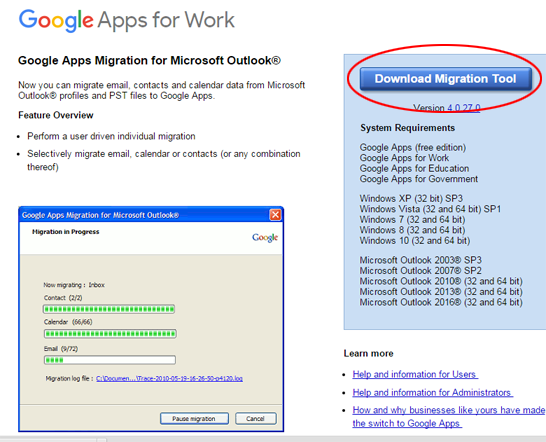
The most common tool used to perform a client side migration is the Google Apps Migration for Microsoft Outlook (GAMMO) tool which is another free tool provided by Google. This tool is also embedded within the Google Apps Sync for Microsoft Outlook (GASMO) application. If choosing to allow users to sync Outlook using the GASMO application, you would only need to download the GASMO tool on the workstations to perform the client side migration rather than also downloading GAMMO as a stand alone tool.
The GAMMO tool only migrates from MS Outlook and when migrating from other mail clients such as Thunderbird and Mac Mail, you will need to rely on 3rd party tools or perform manual exports/imports, both have been known to produce mixed results.
*Client side migrations are ideally performed after the cut-over with the tool only running once to simplify communications, consolidate support efforts, and prevent data duplication (specifically of calendar and contacts)*
PST migration
A PST is a Microsoft file type specific to storing MS Outlook personal folder data, most commonly email messages. The GAMME tool is used to perform PST migrations as one of the migration options available in the tool. You would most likely perform a PST migration in two different scenarios:
- Your internal network can not handle a migration and would prefer to ship the mail files off site to be migrated on another network
- Your only option is to perform a client side migration because of one of the reasons listed above, and you would prefer to have all the client side files aggregated to one machine and migrated by one staff member or consultant rather than individually on each end user’s machine.
*PST migrations are most often performed post cut-over as IT teams would prefer not to perform the logistics of pulling down mail into the PST format followed by running the migration both prior to cut-over and post cut-over as it is time intensive and rarely adds much value opposed to performing the migration only once after the cut-over has occurred.*
Migration Speed
The speed of your migration will be determined by several factors:
- Bandwidth on your network
- Processing power of your migration station
- Number of migration stations running concurrently
- Health and hardware resources on your legacy server
- Total size of data to be migrated
- Google servers’ import acceptance rate (1 message/second)
Change Management
During the migration of data IT teams will periodically need to check in on the status of the migration however much of it is waiting on the data to transfer. During this time it would be advantageous to be conducting change management activities to prepare your end users for the go-live.
Once again the execution and approach to change management can vary greatly depending on the culture of the organization and chosen deployment approach. However below is a list of common activities used by organizations to improve the experience of moving over to Google:
- Assigning “Google Guides” who are either familiar with the technology or are brought onto the platform prior to the company wide go-live. These guides serve as champions of the platform and provide ad hoc support for their fellow end users.
- Providing a series of live webinars prior to and post go-live to give an overview of the technology and answer any end user questions.
- Make your users aware of Google Gooru, which they can visit at their leisure and become more familiar with the platform.
- Sending out a company wide series of emails highlighting the benefits and features of the new platform as well as helpful links and resources.
- Providing a support team onsite and available all day in the days immediately after go-live.
Gammo Tool For Mac Shortcut
Phase 3 of Google Apps deployment is important because it is when all your data is migrated from old legacy systems where data loss can occur. It is also crucial to educate your end users so they are aware of the differences between Google Apps and your legacy system.
This article is Part 11 of Google Gooru’s Comprehensive Guide to a Google Apps Deployment. To access the entire guide for FREE, please fill out the form located here.
Wants to migrate from Zoho Mail to G Suite? Do not know how to move emails from Zoho mail account? Then no need to worry as you are at the right place because here, we have discussed the best solutions to perform Zoho to G Suite Migration successfully. Continue the article below and know more about how it can be done without any loss of data.
Emails have not only become a crucial part of everyone’s life however, it has also turn into an indispensable necessity too. Therefore, it has become really important to keep emails safe and secure. Zoho is one of the widely used online services for emailing and can easily be accessed from the website. It is very simple to use for both the individuals and business users to manage the work in the more proper way. Apart from having so many features, users are still looking for a Zoho to G Suite Migration solution. It is because Zoho is not much secure and advance compared to G Suite. Therefore, users want to switch to other web-based application named as G Suite. Hence, to keep emails safe and secure, we have discussed some techniques to move Zoho emails.
Method for Zoho to G Suite Migration
There is no direct method available to import Zoho Mail to G Suite. Thus, we are here with a method divided into stpes to complete the process of migrating Zoho mail to G suite:
- Extract Emails from Zoho Mail
- Import Zoho Mail in Outlook
- Import PST to G Suite
Step 1: Extract Email from Zoho Mail
In order to export Zoho Mail in .zip format, follow the steps given below:
1. First of all, open Zoho Mail application on the system and click on Settings option directly.
2. After that, choose Mail Settings >> Import/Export Messages option
3. Now, select the folder from where you want to extract emails on the Export window
4. Then, Browse the store location and select the email that you want to export
5. Next, you need to select the duration from the drop-down box and click on the Submit button
6. At times, the request is sent to server queue and you will get the following message:
7. After some time, a notification will be received by you along with the reference URL. Using this URL, you can simply download the required emails in the ZIP format
The URL is sent to the profile through which request is sent and the link is valid only for the next 30 days.
After downloading the ZIP file from the given link, a user can unzip it with the help of WinRAR tool. All the exported emails are in EML file format. Then, transfer EML files to PST format. For this, you need to import EML file into Windows Live Mail first. Then, transfer emails from Windows Live mail to Gsuite. The Zoho Mail to G suite Migration, requires the emails converted to PST as teh Gsuit doesnot have option to import files in EML format.
Step 2: Import Resultant Zoho Mail to Outlook
After importing EML files one by one to Windows Live Mail, its time to import these files to Outlook application and for that follow the steps given below:
1. To import EML files to Outlook, you need to open both Windows Live Mail and Outlook on the system
2. Now, in WLM, navigate to File >> Export email >> Email Messages option
3. From Windows Live Mail export wizard, choose Microsoft Exchange option and click on the Next
4. After that, choose the mail folder that you want to export from Windows Live Mail. For example, choose All Folders option and click on OK button and the export process begin
5. When the process completed successfully, a message pop-up on the screen, click on Finish and exit WLM.
Gammo Tool For Mac Pro
After following all the above steps, the emails from Zoho Mail are exported successfully to MS Outlook application. Now, in Outlook, it is converted into PST file format, which is stored on the local machine at a default location. A user can easily access the resultant PST file from the default location.
Suggestion: The manual procedure discussed above to export Zoho Mail to PST format is not at all reliable method. It is really time-consuming process as it is not a direct solution. Moreover, it requires the installation of both Windows Live Mail and MS Outlook on the system. Therefore, to avoid all such type of hurdles, a user can go with Zoho Backup Tool. This tool directly converts Zoho emails to format without any extra installation. It is an easy, simple, and fast approach to export Zoho emails to Outlook PST format.
4 Step Process to Save Zoho Mail to PST
Step 1: Download and Run Zoho Backup Tool and login with Zoho credentials.
Step 2: Select PST format to download Zoho emails.
Step 3: Browse a location to save Zoho mail in PST file on computer.
Step 4: Click on Start button.
Step 3: Import Zoho Mail to G Suite
After importing emails from Zoho to Outlook, a user can easily import Outlook PST to G Suite application. A user can do this with the help of GAMMO tool (Google Apps Migration for Microsoft Outlook) provided by Google. It is completely free of cost to migrate client-side data to Google Apps. Using this tool, a user can import all data items like emails, contacts, tasks, etc., stored in PST file to G Suite account without any hassle.
Conclusion
Gammo Tool For Mac Osx
Migration of data from application to another over the cloud is very difficult to perform. One such in that is Zoho Mail to G Suite Migration. Users are continuously querying about how to move emails from Zoho email account. As there is no direct solution available that a user can use, therefore, we have discussed an indirect approach that a user can try to perform migration successfully.